
Q&A with Helen Zughaib
Helen Zughaib is a Lebanese-born American painter and multimedia artist living and working in Washington, D.C. She is known for her bright colors, bold patterns, and expressive paintings inspired by Middle Eastern culture and her Arab American identity. Through her art, she aims to promote empathy, understanding, and acceptance between cultures.
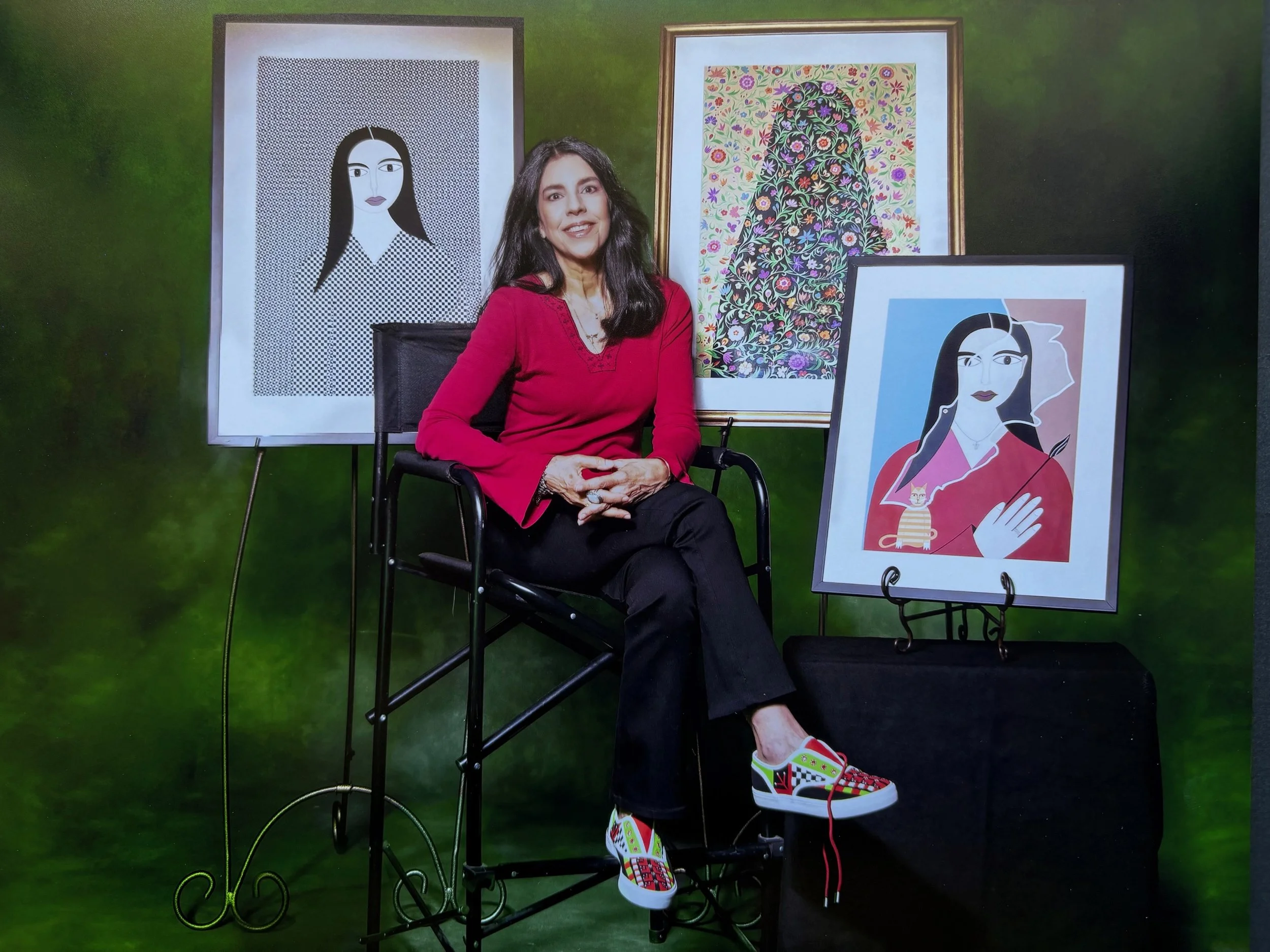
What first got you into art, and what continues to drive you today?
It seems I have always been interested in drawing, even as a young person. Growing up in the Arab world and later in Paris, I was surrounded by art. My parents collected work from major Iraqi and Lebanese artists in the early 60s and 70s, so like I said, it surrounded me. It was also my solace after I was evacuated from Beirut during the civil war. I finished my schooling in Paris and visited the many museums there, especially the Jeu de Paume, where I spent hours before the collection moved to the Musée d’Orsay.
What drives me today? Well, since moving to Washington, DC, where I have lived for a long time now, I find inspiration for my work in what I see around me, from the many monuments around the city to the National Mall. After 9/11 in 2001, my paintings were a more direct response not only to that tragedy but also to the subsequent wars in Iraq and Afghanistan. Wanting to provide another narrative to the negative stereotyping of Arabs and Arab-Americans, especially after 9/11, my work took on another dimension—one that I hoped would create dialogue and begin new conversations between people from both the East and West.
It seems that since that time, my work has continued to respond to global events—specifically in the Arab world, including the Arab Spring, Palestine, Syria, and Lebanon—focusing on women, children, and the conditions they face as a result of war and displacement. I try to emphasize their dignity, resilience, and beauty in the face of untenable situations. I am inspired by their strength.
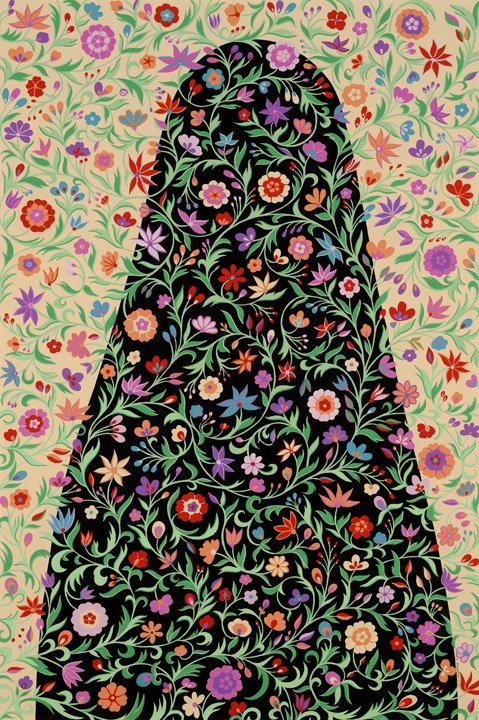
Arab Spring, 20 x 30” gouache on board, 2012
How would you describe your artistic practice to someone encountering your work for the first time?
Well, this is an interesting question! In general, I would say I am a visual “storyteller.” I use bright colors and patterns to define the space I am working with. My work is somewhere between figurative and detailed miniature painting, with odd perspectives and flat two-dimensional subjects. It is definitely not realistic, but not completely abstract either.
Can you walk us through your process, from initial idea to finished piece? How do memory, improvisation, emotion, and imagination interact throughout your process?
So, when I come across something I want to express in my work, whether an event or a series of ongoing issues, I initially use words and very rough sketches of what my idea is. I try to visualize the whole painting first, including a general palette I am thinking of. In my latest body of work that I call the “Migration” series, the paintings follow one another in sequence, so I build from one to the next. The body of work needs to both stand alone and hold together as a group, so I use a similar color palette, shapes, and patterns to define each painting. In general, my sketches are in pencil, then a more detailed sketch on the actual board I am using, and then I paint in gouache, an opaque watercolor. I mix my own colors and love using this particular paint as it affords beautiful, clean, and flat colors. It dries quickly, which can be both good and bad!
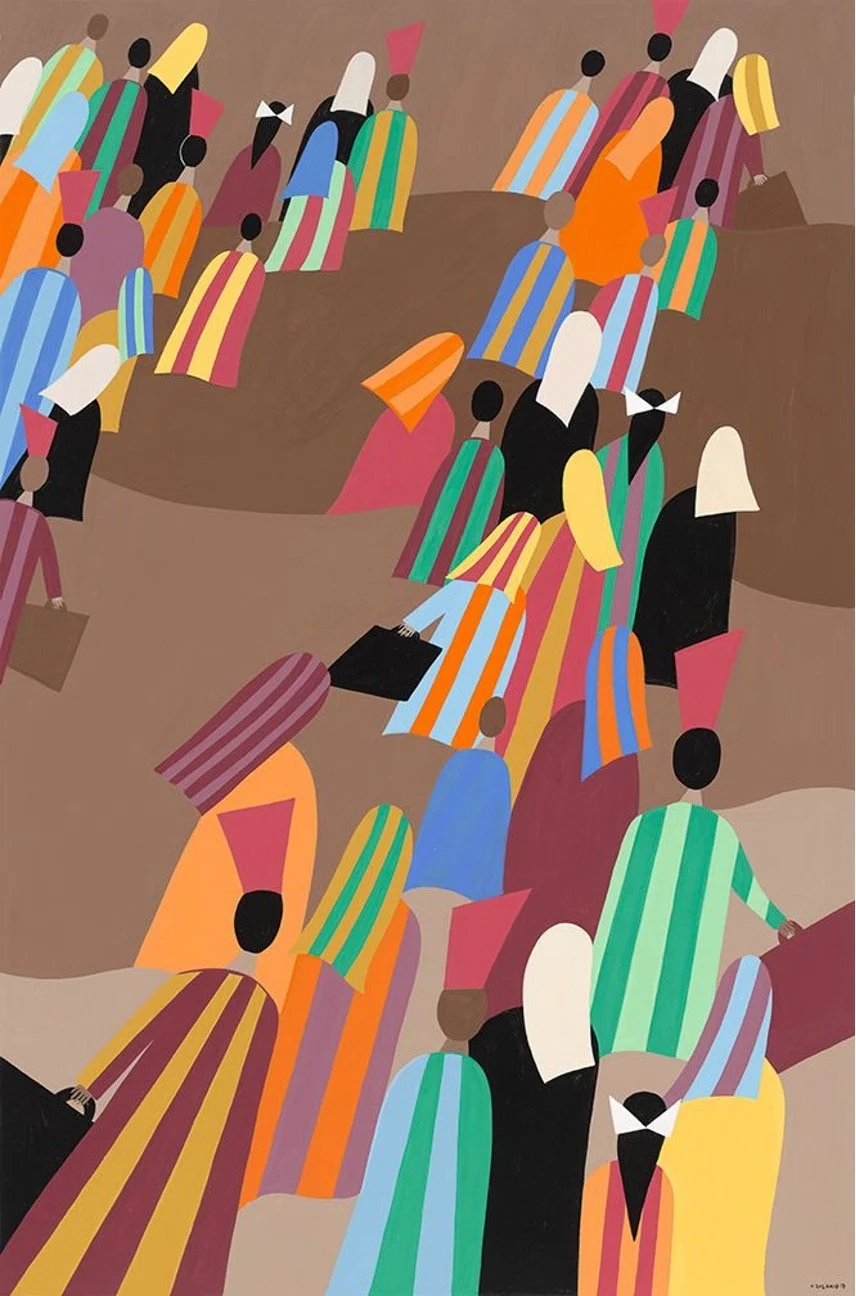
Syrian Migration #7, 12 x 18” gouache on board, 2017
How does your Lebanese heritage and broader cultural background influence your artwork and the ideas you explore?
I think that, even though I have lived here in America longer than I have lived in Lebanon at this point, my background never leaves me. Maybe it is even stronger than if I had been able to stay in Lebanon—I wonder about that all the time. Perhaps nostalgia and memory replace reality?
I have been back to Lebanon a few times since the war. Each time I am enriched and inspired by new stories. I feel a responsibility to tell stories of that part of the world, from an authentic voice as opposed to our stories being told by someone else with little or no connection to the Arab world. It is important to me to create a platform through my work and “stories” that cultivate some understanding between cultures, specifically between East and West. I hope to create a dialogue that leads to respect for one another, and maybe even empathy.
Your work often brings together Middle Eastern and Western cultural influences. How do you navigate that intersection, and has your relationship to those influences changed over time?
Well, as an Arab American, many times I feel as if I try to combine the two “sides” of me into one—a space where they both “live,” as opposed to feeling as if I do not truly belong in one culture or the other. It is a near-constant preoccupation for me. In some of my work, I manage this by bringing together the East and West successfully, as in a series I did called “Challenging Perceptions.” This series was in response to the invasions of Iraq and Afghanistan after 9/11. The abaya was portrayed in stereotyped and negative ways by the media covering the wars. In these paintings, I took inspiration from well-recognized Western artists (Mondrian, Picasso, Lichtenstein, etc.) and combined their styles with the black abaya, creating a space for conversation to think about the garment and provide a new narrative surrounding it.
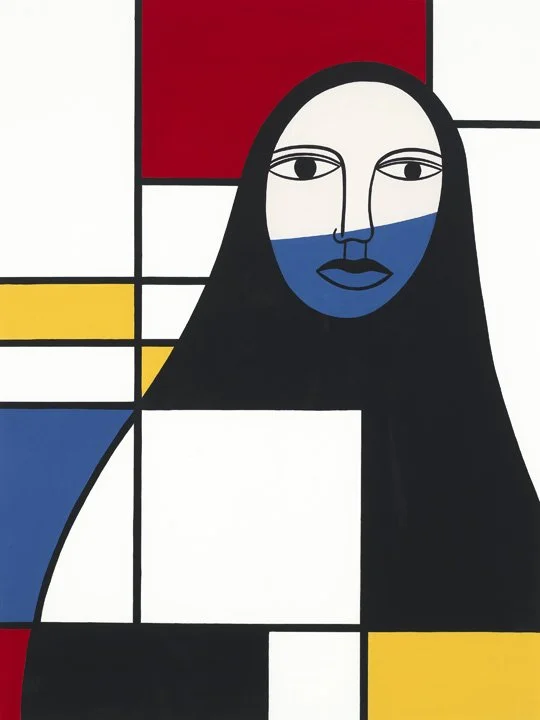
Abaya Mondrian, 15 x 20” gouache on board, 2008
Has making art changed the way you understand your own identity? If so, in what ways?
I guess in some ways my identity with Lebanon and the Arab world has become stronger. I think given the subjects I try to tackle and talk about in my work—stemming from that part of the world—many times I am labeled as an Arab or Arab American artist, which further pushes the narrative. It does not bother me as that is how I see myself: as an Arab American. I think actually, this duality has made me a stronger person, able to reflect both from the inside and as well as the outside. It was a place that felt uncomfortable to me as a younger person, but now I have grown into that space and am able to relish it and keep learning from it.
Your work is known for its vivid colors, stylized figures, traditional Arab motifs, and intricate designs. What do these visual elements mean to you, and what do you hope to convey through them?
In the first question, I answered about influences in my work. Growing up in Lebanon, Iraq, and Kuwait, patterns and color were all around me in the carpets, textiles, ceramic tiles, mosques, churches, souks, and bazaars. The flatness of these patterns and designs, and of course the colors, has always appealed to me as a visual artist. And in many of the textiles, the embroidery motifs tell their own story. Where a person comes from, for example, could be “read” from their thobe. They show what plants and animals are important to them, and the meanings behind many of these stitches are used to inform and teach younger generations and to preserve and respect their culture and heritage.
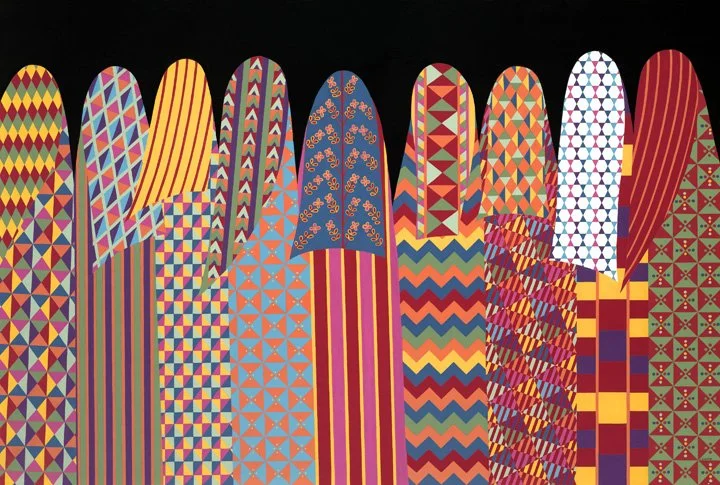
Women Against the Might, 20 x 30” gouache on board, 2009
What role does emotion play in your work, particularly when you engage with themes of displacement, migration, memory, and belonging?
I am always emotional about my work. In general, I am trying to portray a situation or something that is important to me. With the war in Syria, for example, which lasted fourteen years, many of my “Migration” paintings were very difficult to paint given the subject matter. While working on a few pieces over the years, the subject was so devastating that I have actually cried over the paintings. I have been working on a new series of work, “Where Are You, Banksy?”, reflecting the devastation and war on Gaza and the West Bank. Using collage from newspapers and gouache, the images are incredibly painful and hideous. To create work from the fast-moving cycle is to keep this horror from being forgotten. In this series, using actual news articles creates an immediacy that I feel is relevant and powerful.
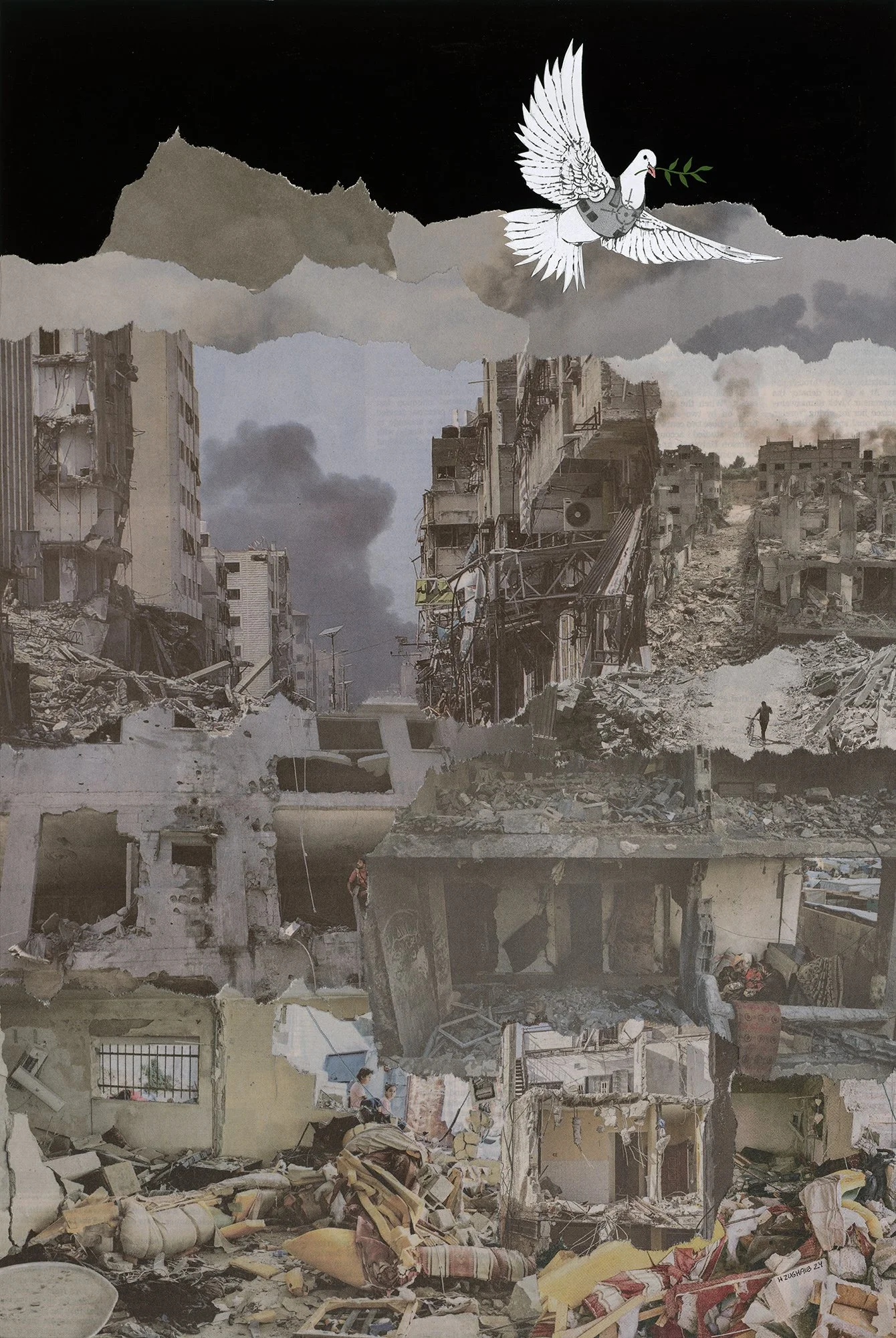
Where Are You, Banksy? 12 x 18” gouache and newspaper, 2024
Do you think of your artwork as a way of preserving or reconstructing memories? What kinds of memories feel most important to preserve?
Well, I kind of made reference to that in the last question. I think we live in such a fast-paced world, with social media and news stories that come so quickly, that it is easy to forget them. That is why I spent over a decade visually recording the war in Syria and the aftermath of the Arab Spring. In my series “Syrian Migration Series,” I created 58 paintings accompanied by short narratives for each piece, further emphasizing the importance of the events I was portraying. In a different body of work, “Stories My Father Told Me,” a series of 25 paintings inspired by my father’s stories from Damascus and Lebanon until he immigrated to America, I do absolutely try to preserve his memories. Through both his stories and my paintings, I hope to share his world with a larger audience.
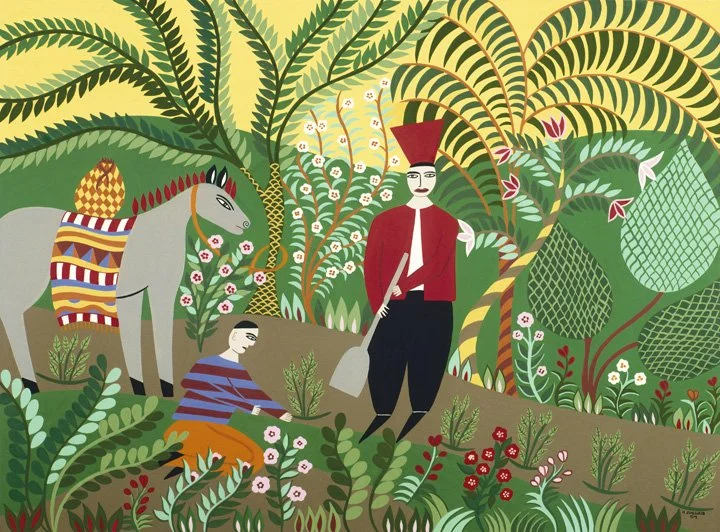
Planting Olive Trees with Jiddu, 15 x 20”, gouache on board, 2005
What do you hope viewers take away from your work? Have viewers ever interpreted your work in a way that surprised you?
I think what I hope for the most is that the viewer comes away with feelings of empathy and understanding, ultimately seeing that we are more similar than we are not. I also hope my work inspires dialogue and a deeper reflection of current situations in a nonjudgemental way.
Looking back on your career, is there a moment, exhibition, or artwork that remains especially meaningful or memorable to you? If so, why?
I feel fortunate to have had many wonderful exhibitions and opportunities that I am very proud of. But one moment particularly stands out. My painting “Prayer rug for America” was created in response to the tragic events of 9/11 in 2001. This painting was acquired by the Library of Congress, a huge honor and definitely a highlight of my career as an artist. The Library of Congress subsequently acquired several other paintings of mine in the following years. The paintings are available for viewing and studying by the public. They will remain there long after I am gone, and a huge honor for sure!
I would also have to say another major highlight of my career was to have President Obama give one of my paintings to the Prime Minister of Iraq at the White House.
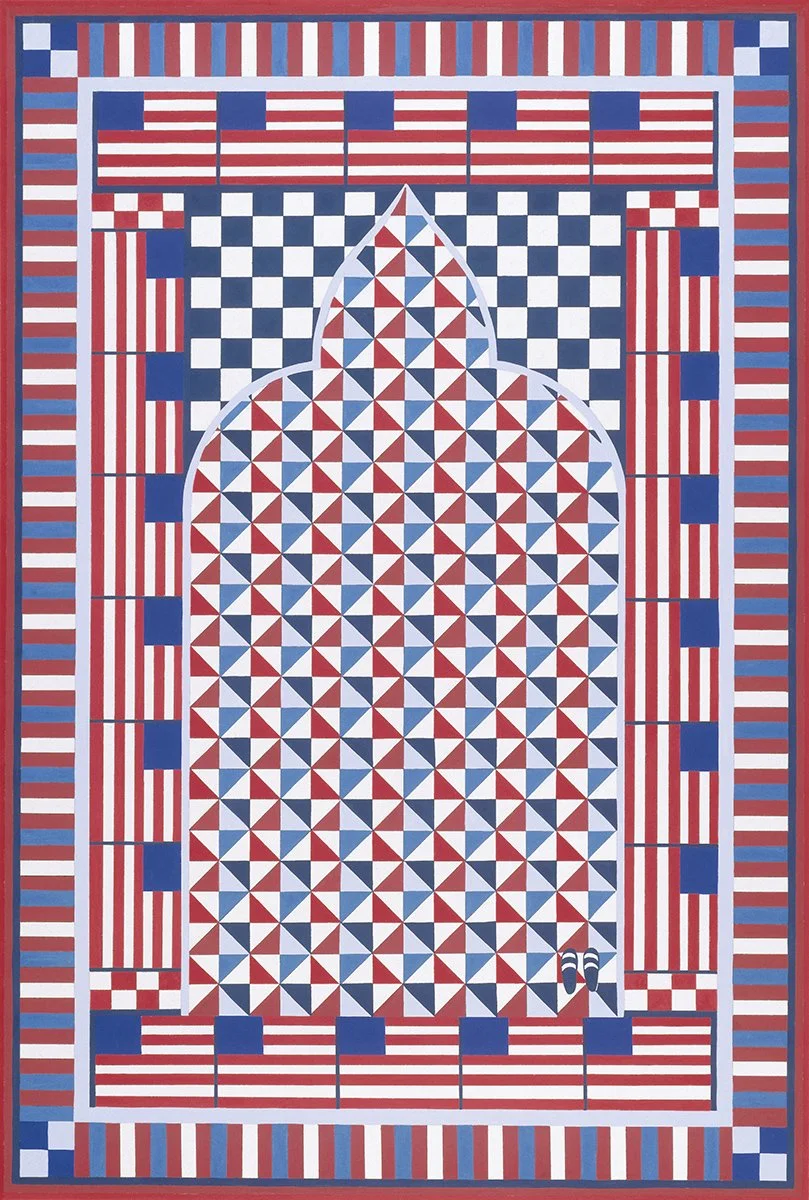
Prayer Rug for America, 20 x 14” gouache on board, 2001
